
Lebanon City Directory Collection Leads
Lebanon has a strong local-history circuit, but its public web sources do not publish a complete Lebanon-only city-directory shelf list. That means no exact publisher, starting year, ending year, or reverse-directory run should be assumed before a title page is checked. The best first contact is the Warren County Genealogical Society, whose research page names City Directories as a category but marks its directory inventory “Under Construction.” The Lebanon Public Library is a convenient first stop for family and county histories plus in-library Ancestry and FamilySearch access. Harmon Museum and the county archives add newspapers, maps, tax, court, cemetery, and family material that can test a directory clue.
| Collection lead | Years or status | Where held | Access |
|---|---|---|---|
| Lebanon city directories | Exact local run not publicly listed | Warren County Genealogical Society | Ask for shelf list and any reverse or criss-cross volumes in person |
| Ohio and regional directories | Broader collection includes volumes as early as 1819; Lebanon run unverified | Cincinnati and Hamilton County Public Library digital collection | Search full text and download candidate volumes |
| Western Star and related titles | 1807–2013; some issues missing | Ohio Memory, WCGS, and Harmon Museum | Free search/browse online, with microfilm and hard-copy fallback |
| County historical records | Marriage 1803–1996; estates from 1800; tax duplicates from 1809 with gaps | Edna L. Bowyer Records Center & Archives | Reading-room research for holdings at least 75 years old |
Call WCGS before a visit rather than treating a category label as proof of a particular book. The society is in the lower level at 406 Justice Drive, open weekdays 9–4, and can be reached at 513-695-1144. Its FamilySearch Affiliate Library status can also matter when a digitized image has location-based access limits. The nearby public library, at 101 S. Broadway, describes its genealogy collection as minimal, so it should not be presented as a confirmed directory shelf.
Note: A title page and its abbreviation key are the evidence for a Lebanon directory year, publisher, and coverage, not an unverified online claim.
Lebanon City Directory Research Desks
Each Lebanon institution answers a different part of a household question. WCGS is the specialist directory and genealogy desk. The Lebanon Public Library offers a service-desk starting point and in-library databases, with hours Monday through Thursday 10–8, Friday and Saturday 9–5, and Sunday 1–4 from October through April. The Records Center supplies older county records. Harmon Museum’s Mary W. Klei Research Library is the local-history desk for family, property, church, atlas, cemetery, court, tax, photo, Shaker, Quaker, and newspaper material.
Warren County Genealogical Society
406 Justice Drive, lower level, Lebanon. City Directories is a listed research category; exact holdings need desk confirmation.
Mary W. Klei Research Library
105 S. Broadway. Research hours are Tuesday and Thursday 10–4, with historian assistance and a paid remote-research option.
Records Center & Archives
406 Justice Drive, Room 052. Its archival holdings date to 1803; records at least 75 years old are researchable there.
The access split is important. Newer records belong with the office that created them, while the Records Center makes the older collection available in paper, electronic, and microfilm forms. For a current address or parcel question, use the Lebanon by-street directory and the county property trail instead of forcing a historical directory to answer a modern question.
Western Star Context for Lebanon Addresses
A directory-style listing gains meaning when a local newspaper confirms the same name, address, business, move, marriage, death, or civic event. WCGS’s Alleen Stephenson Digital Newspaper Project provides free access through Ohio Memory to 178,510 digitized pages in 9,909 issues. Its central paper, the Lebanon Western Star, ran from 1807 to 2013 and began with John McLean. It is an unusually long local chronology, yet some issues are missing and a search result is still a historical clue rather than final proof.
The archive is more than one title. Search Western Star & Lebanon Gazette, Star & Gazette, Weekly Western Star, Lebanon Daily Star, and Western Star and the Lebanon Patriot when a name seems absent. Try the original spelling, initials, street, and a nearby date. Then browse adjacent issues when optical character recognition misses a name.
See the WCGS Western Star project that supplied this archive image.
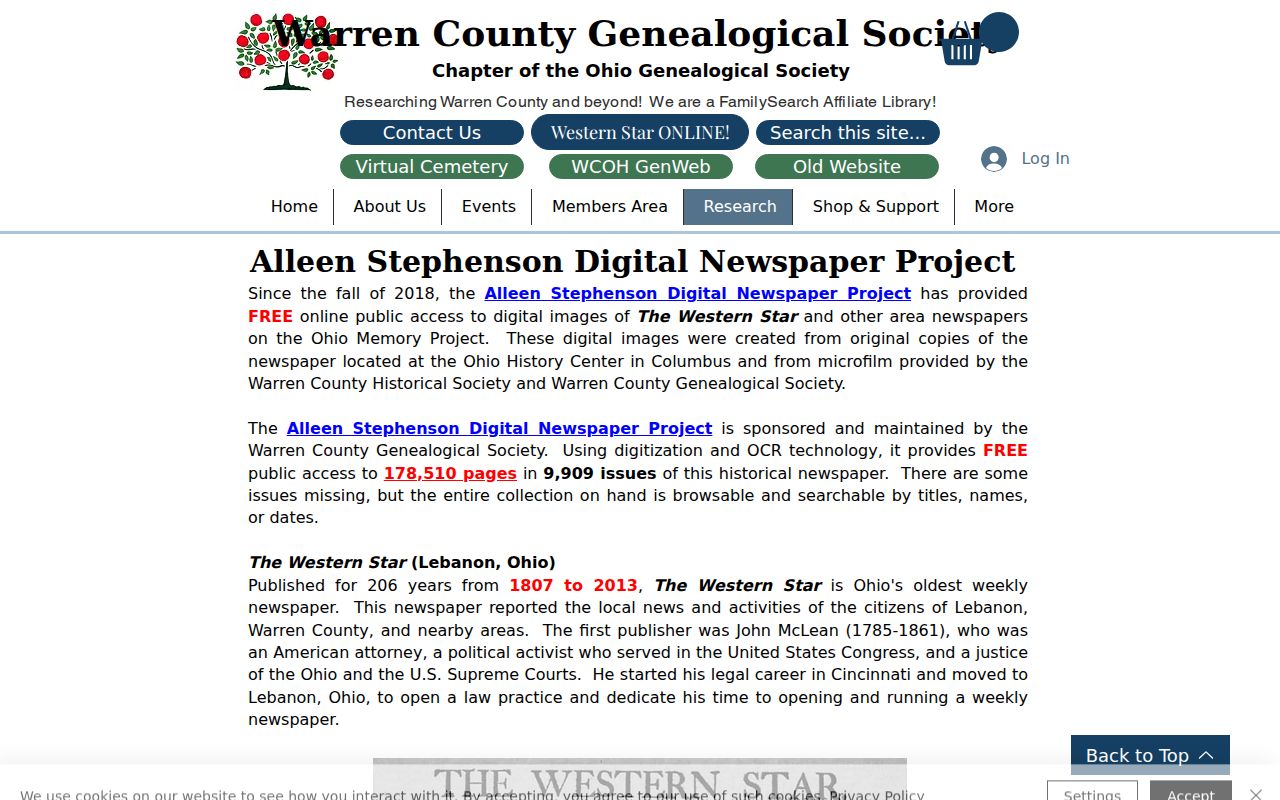
Harmon Museum reports that its library keeps the complete Western Star archive in hard copy and microfilm. That local format is the sensible fallback for a poor scan, a missing online issue, or an OCR result that does not match the printed page.
How Lebanon City Directory Entries Read
No official or local source in this research pass supplied a page image from a specific Lebanon city-directory volume. The exact entry format, publisher, and abbreviations therefore remain unverified. A careful reader starts by photographing or noting the title page, the date, the communities covered, and the abbreviation key in that very volume. General city-directory conventions can guide what to inspect, but they cannot be represented as a Lebanon transcription until the book itself is checked.
| Name | Record the surname, given name, initials, and spelling exactly as printed. |
|---|---|
| Household clue | A spouse or widow reference may appear in some volumes, but only the printed key explains its local meaning. |
| Occupation | Copy any stated trade, business, or employer as a dated clue, not a current identity claim. |
| Address | Preserve house number, street spelling, and any residence notation before comparing maps or tax records. |
| Ownership mark | Do not infer an ownership or occupancy status unless the particular volume defines its symbol. |
- Criss-cross directory
- A street-order listing that can group entries by address. WCGS should confirm whether one exists for the requested Lebanon period.
- Householder index
- An index organized around the person or household carrying the listing, rather than proof of every person at that address.
- Abbreviation key
- The publisher’s explanation of shortened terms and symbols, often near the front of the volume. It must be copied from the specific book.
That restraint prevents a common mistake: turning an unverified generic convention into a fact about Lebanon. An entry may point to a household, but it does not by itself establish legal ownership, a complete family, or a current residence.
Unverified Lebanon Directory Runs
The local gap is specific. No exhaustive online shelf list establishes the Lebanon-only years, publishers, old telephone-book series, or reverse-directory run. No verified online sample supplies a title page plus entry and abbreviation key. No official local source verified a Sanborn sheet inventory for Lebanon. These are research tasks for WCGS, Harmon, the Ohio History Connection, or the Library of Congress, not facts to fill in from a generic directory list.
The broader Cincinnati and Hamilton County Public Library directory collection is a legitimate online lead. It contains Ohio and Kentucky material with volumes as early as 1819 and can be searched full text. A researcher still needs to confirm that a result actually covers Lebanon or Warren County, identify its publisher and date, and preserve the title-page details before treating it as a local volume.
View the regional historical directory collection used for the searchable-catalog lead-in.
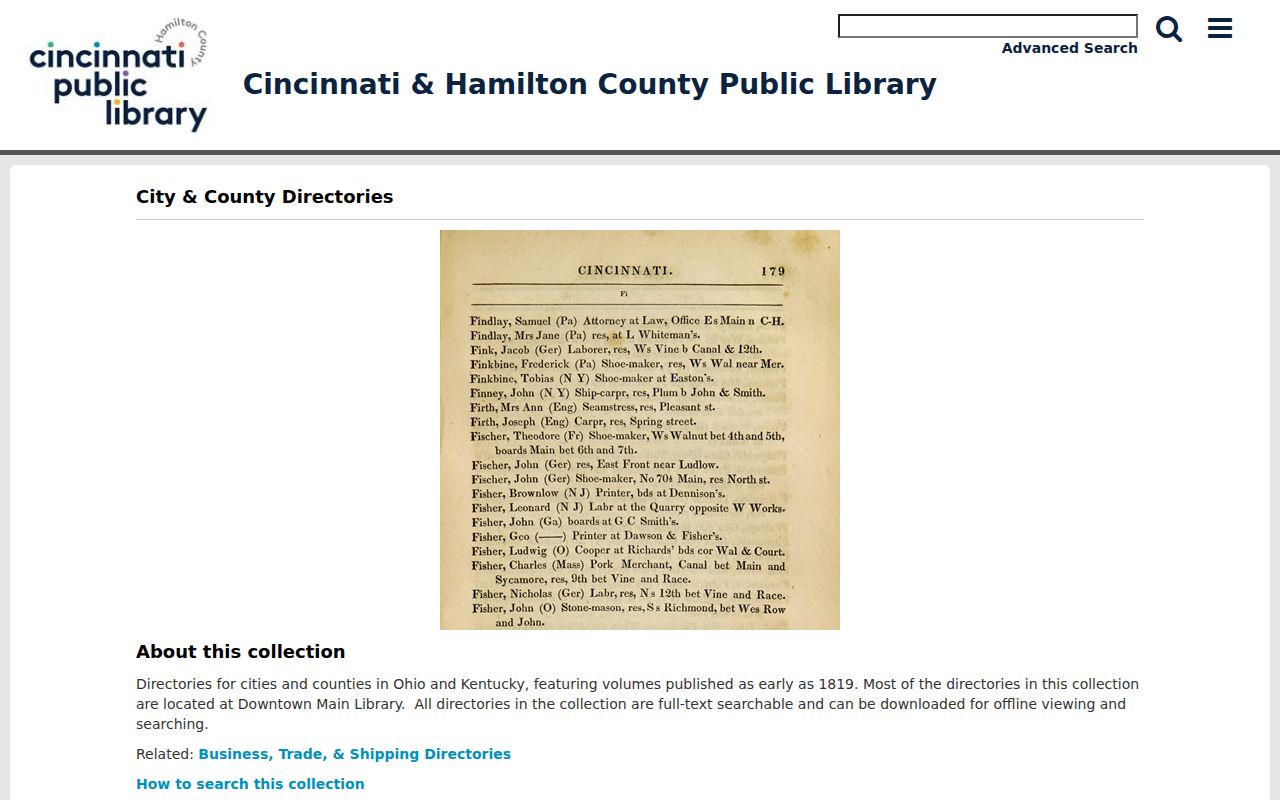
The regional collection helps locate candidates, but it does not remove the need to verify a Lebanon title page and local coverage. That distinction keeps a search trail accurate when nearby cities and counties appear in the same digital shelf.
Trace Households With Lebanon Directories
Historic household work starts with a dated entry, not an assumption that the same surname is the same person. Request a Lebanon volume for the estimated decade, then copy the name, initials, address, and occupation exactly. Ask whether a reverse or criss-cross section exists for that date. The later steps turn a directory clue into a record trail by testing it against the newspaper, the nearest released census, and county records that can confirm a parcel or estate connection.
- At WCGS, ask for the directory shelf list for the surname, address, and estimated decade, including any street-order volume.
- Record every printed detail and the title-page citation. Keep original address spelling rather than silently modernizing it.
- Search the same name, address, and business terms in the Western Star archive, including the title variants and nearby issue dates.
- Pair the entry with the nearest public federal census. The census is a household snapshot, not an annual substitute for a directory.
- Use tax duplicates, deed records, probate, obituary, or cemetery material to corroborate the person, property, or family transition.
A name that vanishes may signal a move, death, changed initials, a missing volume, or a different listing choice. Check each possibility against dated evidence. When a directory clue needs present-day confirmation, a Lebanon resident lookup can use the appropriate current official record instead of projecting the historical entry forward.
Note: A census and a directory can support each other, but each records people on its own date and neither automatically resolves a same-name match.
Lebanon Archives and the 75-Year Split
Warren County was organized in 1803. The Records Center says its holdings date to that year, while WCGS cautions that a record from before May 1803 may require a Hamilton County search. The center makes records 75 years and older researchable in its reading room, but newer material must be requested from the originating department. That year-based handoff is a practical insider tip when an old household trail moves from a digitized newspaper to a county volume.
The local guide gives useful dated series: wills and estates from 1800, marriages from 1803 to 1996, births and deaths from 1867 to 1908, and tax duplicates from 1809 with gaps. These are companion sources, not directory replacements. They can corroborate a name or family transition that a historical listing suggests, while their limits and gaps remain visible.
Ohio Memory hosts the digitized newspaper collection that helps bridge those gaps.
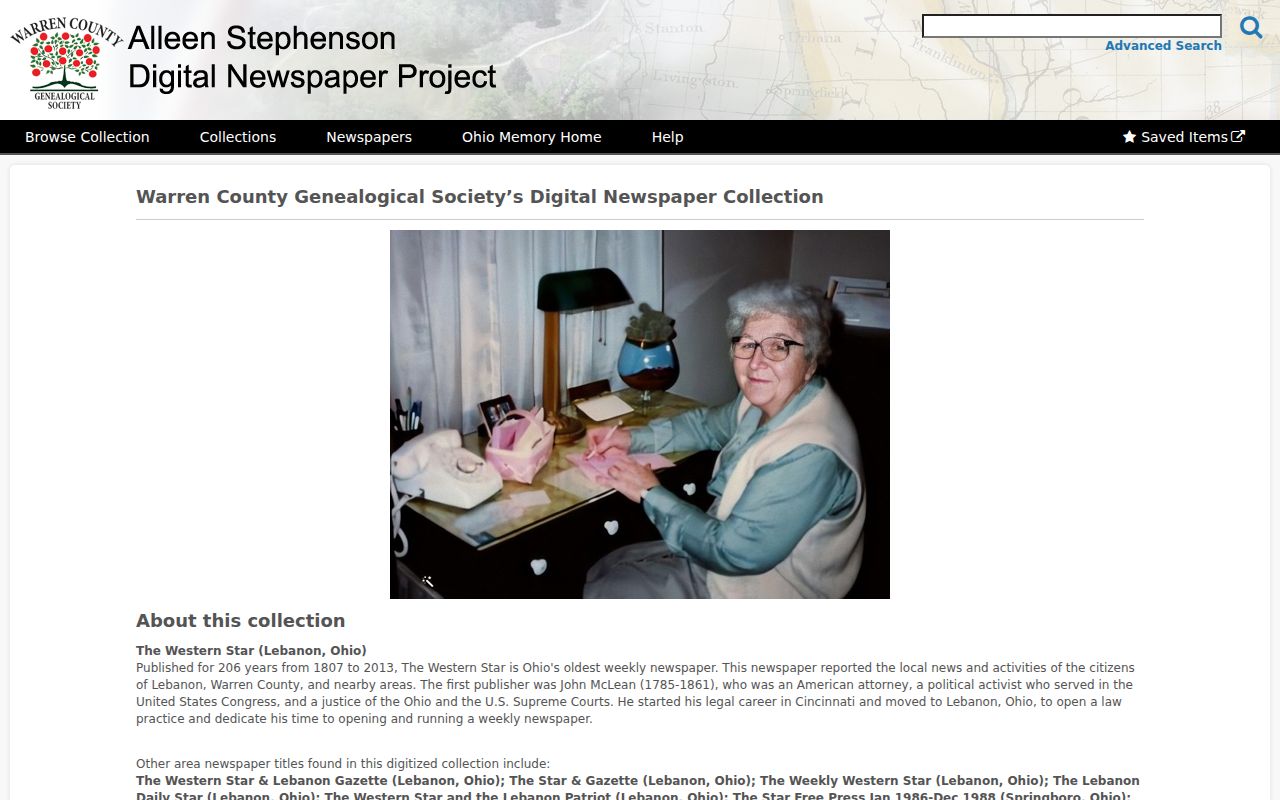
The online archive and the local reading rooms complement each other. A search hit can supply names and dates, while original, microfilm, or county records provide a clearer page and a stronger way to test the finding. Harmon’s Mary W. Klei Research Library also offers a $5 preliminary search, then $10 per hour for members or $20 per hour for nonmembers, plus copy and shipping charges. Requests should include names, dates, known facts, and desired research time.
Harmon Help for Lebanon Research
Mary W. Klei Research Library is a focused fallback when a Lebanon directory, newspaper, or map question becomes too local for a general catalog. Its collections include Shakers and Union Village, National Normal University, local churches, court records, family files, atlases, photographs, cemeteries, tax material, and newspapers. Those sources can give context to a name or address found in a city directory, especially when a household changes name, moves, or appears in an abbreviated listing.
The research desk is open Tuesday and Thursday 10-4 with historian assistance. Its paid staff search is not a substitute for checking a title page, but it is a documented way to ask a precise question about family, property, or Warren County history. Give the researcher the person’s name variants, possible date range, address spelling, and the known directory or newspaper citation. That detail makes it possible to search the right file, atlas, or microfilm series without treating a broad people search as a records request.